Showing posts with label armor of God. Show all posts

Sunday, September 23, 2018

Armor of God: Shield of Faith

Dear Readers,

Continuing with the armor of God series, we are on to the shield of faith. Ephesians 6:16 "Above all, taking the shield of faith, wherewith ye shall be able to quench all the fiery darts of the wicked."

What is faith? Prophets in the Book of Mormon taught: "And now, as I said concerning faith - faith is not to have a perfect knowledge of things; therefore if you have faith ye hope for things which are not seen, which are true." (Alma 32:21). "And now, I, Moroni, would speak somewhat concerning these things; I would show unto the world that faith is things which are hoped for and not seen; wherefore, dispute not because ye see not, for ye receive no witness until after the trial of your faith." (Ether 12:6). Thus we see that faith is a hope, or trust, in unseen things that are true.

This truth is not the relativistic truth, which differs from individual to individual. Instead, this truth is God's truth, "And truth is knowledge of things as they are, and as they were, and as they are to come." (Doctrine and Covenants 93:24). This truth is ultimate, universal truth.
Sinnah shield image link
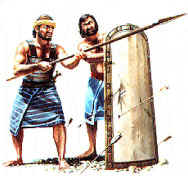
Knowing that faith is hope or trust in things that aren't seen but are ultimately true, we can talk about shields. There are various types of shields, each with its own symbolism. It is also interesting to see the evolution of shields. In ancient Israel, they had two main types of shields the magen which is a small, round buckler, and the more often used sinnah. The sinnah was more like a square shield the height of a man, heavy, and would rest on the ground. In battle, one Israelite would hold the shield while another, usually a pikeman or romah wielder, would attack from the side. In this way we see the trust required, for the pikeman is relying on the shield holder for protection while the shield holder relies on the pikeman for protection from the flanks or sides.
Siege Mantlet image link
It is also interesting to note that the word "sinnah" later represents a siege mantlet, which consists of two shields set on wheels with a pivot bar, allowing them to be stationary or become mobile. Thus symbolizing both steadfastness in our faith, being planted on the foundation of Christ, and moving forward towards our goals.
Roman Parma image link
While closer to Christ's time the Romans had interestingly similar shields. The parma were round like the magen, but larger than a buckler, and also rather flat, besides the metal boss or umbo in the center. This hard protruderence then allows the shield to be used to also push back against the foe.
Spartan Phalanx from 300
However, the clipeus was used more near the end of the Roman Empire. These shields were modeled after the Greek aspis made famous by the use of Spartan phalanx in the movie 300. In this formation, the shield covers thigh to neck of the person to their left. This symbolizes how we need to use our faith to help our neighbor.
Parable of the Ten Virgins from the Gospel Artbook
As with the parable of the 10 virgins (Mathew 25:1-13), we cannot give someone our faith, or the oil in our lamps, but it can provide light and an example so that we can be prepared for ourselves, and encourage others to obtain light or oil for themselves.

Clipeus of Jupiter image link
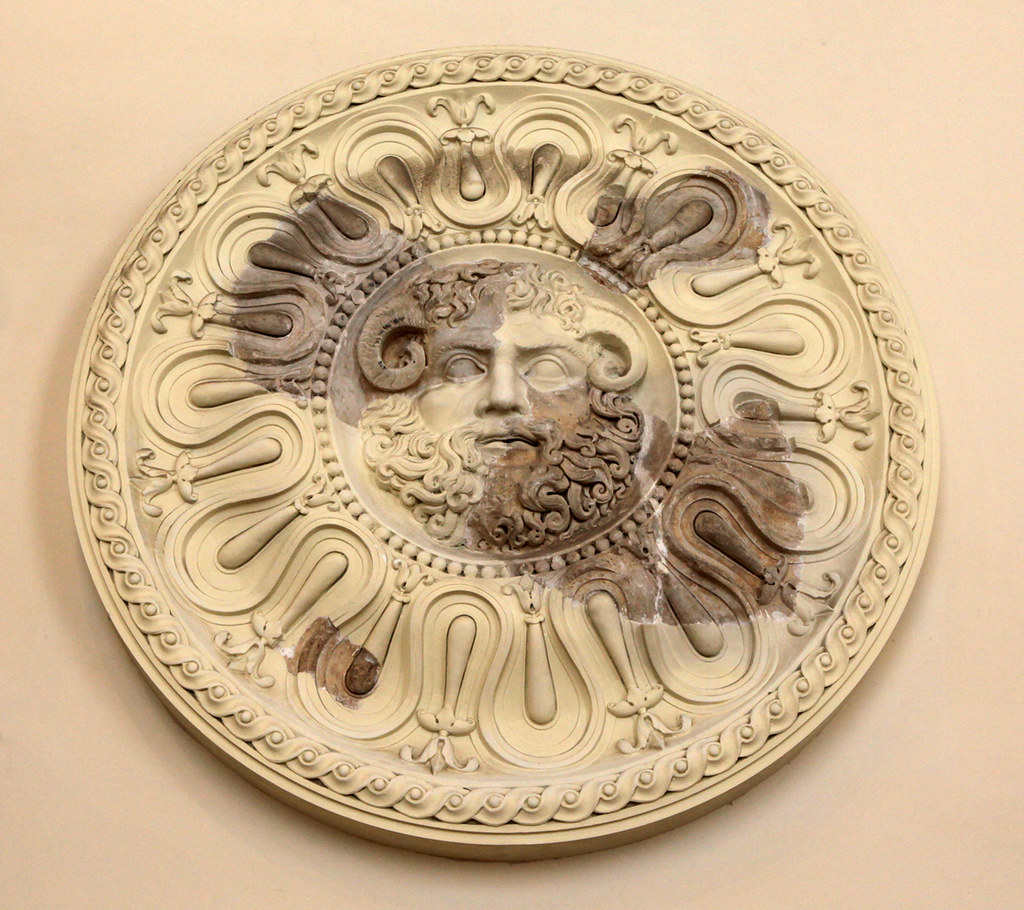
Yet the clipeus is different from the aspis in a visual dynamic. This shield usually has the impression or etching of a Roman god upon its face. It is essential that we remember who we must have faith in, God the Eternal Father, His Son Jesus Christ, and the Holy Ghost. They are the ones who protect us because of our faith, and who also act upon our behalf,
Testudo Formation image link
Lastly there is the Roman Legionaire scutum. Again, like the sinnah of ancient Israel, it was a tall rectangular shield. When used in the testudo or tortoise formation it protected the soldiers from forward attacks as well as projectiles from above, quite similar to a turtle retreating into its shell.
Droideka or Droid Destroyer from Star Wars II: Attack of the Clones
In the evolution of shields, there is that growing need to be protected from all sides. The great Adversary of all is tricky, and attacks us in our blind sides, wherever we are the weakest. This is why, I personally, like to think of the shield of faith like a personal forcefield.
Ancient Personal Shield Emitter from Stargate Atlantis Season 1 Episode 2: Hide and Seek
Like an energy shield made of plasma, ideally, it protects from all sides.

However, we can't forget the previous lessons: it is God who gives us this power and strength to protect ourselves, we need to use our faith to reach out and help others as well as ourselves, we have the ability to not only defend but push back against the foe, that we may push through the adversary's lines and reach our goal of returning to our Father in Heaven.
No wonder the CTR (Choose the Right) rings became so popular among Latter-day Saints. The idea that using our faith to choose righteousness simplifies all theses ideas. For, if we choose to do what is right, then we we are pressing forward towards God, moving through and past the temptations that try to distract us and lead us away, and help others along our journey home.
Also, the shape of the CTR shield reminds me of the shields on the newer US pennies. Inscribed on this shield is the United States motto "E Pluribus Unum" which is Latin for "Out of Many, One". It serves as a reminder that thought the North American States were many, they have become one nation. Likewise, though there are many believers, as we come together in truth and faith, we become one church, one body of Christ (Romans 12:5).

Lastly, what does it mean to "quench all the fiery darts of the wicked"? To quench means to put out a fire, usually using water. Like quenching a thirst, it satisfies and cools. Usually, I have thought of this "quenching" like the shield spell in Dungeons and Dragons.
image link
This shield protects against some attacks, but it completely nullifies a powerful spell called magic missile. I have imagined our spiritual battle in a similar way, a forcefield that quenches fiery "magic missile" darts making them vanish as they strike the barrier.

However, it is unlikely that this is what was originally visualized with this scripture. For in Christ's time, fiery darts would be more like arrows lit on fire with oil. Their flames would be quenched by lack of air, such as being embedded in a wooden shield. It does not say that the arrows won't come, nor that we won't feel the impact, but it does say that the fire will be quenched, removing the sting, pain, and suffering that would otherwise befall us if we were not protected.
Arrow Training in How to Train Your Dragon
It is also important to note that the scripture could have said arrows, but instead it said darts. Small projectiles, just as Satan and the wicked take small jabs at us, poking and prodding for our weaknesses.

May we take up our shields of faith, trusting in God, and quench these darts, that we may be strong enough to return home to our God and our Savior Jesus Christ. In His name, amen.

Love,
Jacobugoth

Previous: Feet Shod                                                                         Next: Helmet of Salvation

Tuesday, February 27, 2018

Armor of God: Breastplate of Righteousness

Dear Readers,

There is some hesitation with me, for fear of being too redundant with these posts, but it is difficult not to go through different articles of armor without redundancy. That being said, let us begin with the medieval.
Balthasar Cuirass from Medieval Collectibles
The medieval breastplate is called a cuirass, and is made to protect the vital organs withing the chest and abdomen. I thought it was interesting how similar the word cuirass is to carapace. A carapace is the hard outer shell of a turtle, crustacean, or arachnid. Essentially it is the densest part of the exoskeleton. It seems quite fitting that the hard metal shell of a breastplate be compared to the hard protective shell of a turtle.
Image Link
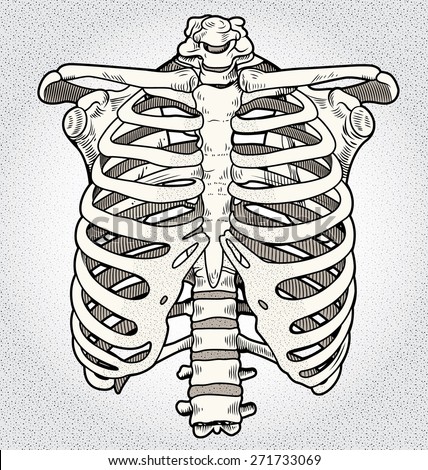
Besides these artificial exoskeletons, human have their own internal breastplate we call a rib cage. This thoracic cage helps to protect the lungs, heart and other organs of the chest cavity. However, there are the "chinks" in the armor between the ribs. Sadly, Satan tries to get at us through these kinks in our "natural" state, metaphorically speaking. Which is why we have to do our part to protect ourselves with righteousness.
Though a medieval cuirass is likely the most popular version of the breastplate of righteousness we see illustrated, Paul likely had the Roman breastplate in mind when he spoke about the armor of God (Ephesians 6:14). These breastplates have various names including muscle cuirass, anatomical cuirass, or heroic cuirass. Clearly there is the hint of Greek influence because of the use of muscular architecture in the armor. It is intriguing how righteousness can be like a muscle. Every day one has to work and labor to get righteous, and stay righteous, otherwise progression stops, muscles atrophy and spiritual strength is lost.
George Clooney in Batman & Robin
Now, what is most hilarious is what I would classify under the "anatomical cuirass" title: the use of nipples on the armor. I realize that it has been a clever slogan because of the humor found in Batman & Robin, but I cannot see armor like this without thinking, "Holy Bat-Nipples, Batman". Just remember Batman's armor and suit when thinking about the armor of God... (raspy voice) "I'm not wearing hockey pads... I'm wearing the armor of God!" Alas, jokes aside, there is a more spiritual breastplate to talk about now.
The Alchemist 6: Urim and Thummim by Blu3berrystar from Deviantart.com
It is likely that the breastplate of judgment was the kind of breastplate that Isaiah was referring to in his use of the armor of God (Isaiah 59:17) for he lived long before the Roman invasion of Israel. This breastplate of judgment had various gem stones (Exodus 28:17-20), each representing one of the twelve tribes of Israel (Guide to the Scriptures: Twelve Tribes of Israel).
Image Link
These breastplates of Israel were a sheet of metal, gold for the breastplate of judgment in the temple, and would only cover the front of the individual. I have mentioned how the rectangular shape of the breastplate of judgment is similar to those found in the eastern American Indian ruins in my post about the Geography of the Book of Mormon. However, the shape and intricacy of the breastplate of judgment had another purpose.

"And thou shalt put in the breastplate of judgment the Urim and Thummim; and they shall be upon Aaron's heart, when he goeth in before the Lord: and Aaron shall bear the judgment of the children of Israel upon his heart before the Lord continually." (Exodus 28:30) The breastplate of judgment was made to support the Urim and Thummim.
Joseph Smith Urim and Thummim Illustration by Robert T. Barrett
Bible Dictionary defines the Urim and Thummim as a "Hebrew term that means 'Lights and Perfections." An instrument prepared of God to assist man in obtaining revelation from the Lord and in translating languages... There is more than one Urim and Thummim, but we are informed that Joseph Smith had the one used by the brother of Jared." There is a partial description given by Joseph Smith in his history 1:35, "Also, that there were two stones in silver bows-- and these stones, fastened to a breastplate, constituted what is called the Urim and Thummim--deposited with the plates; and the possession and use of these stones were what constituted 'seers' in ancient and former times; and that God had prepared them for the purpose of translating the book."
Image from "Are crystals and gems used in the bible" blog post by Thesoulintention
Surprisingly, I found that Jewish tradition has one of these stones white, and the other black. As I mentioned in my post about Light, that the color of white is produced by all of the spectrum of visible light reflecting off the object, and made a correlation between light and knowledge and intelligence. Thus it is fitting that a white stone represents complete light for the "complete" light that we can see is being reflected to the viewer. It is also amazing how complete truth is represented by a black stone, which absorbs all the visible spectrum of light. It holds it all, it contains it all. All truth, things as they were, and as they are, and as they are to come (Doctrine and Covenants 93:24).
Biographical Sketches of Joseph Smith The Prophet and His Progenitors for Many Generations by Lucy Smith page 101
My portrayal of the combination of both types of Urim and Thummim described.
Yet, if the Urim and Thummim were comprised of these stones, why have this gift of God been described so similar to spectacles or glasses? Based off of Lucy Smith's eye witness account, they were triangular diamonds set in glass, but to remember, this was the Urim and Thummim that the Brother of Jared used and thus was from before Abraham's time, for the Jaredites fled the eastern world to the Americas at the time of the tower of Babel and the confounding of languages (Guide to the Scriptures: Jared, Brother of). Wherefore, it was before Israel's day and thereby before the law of Moses and the use of the tabernacle, and thus it was likely that there would be some superficial differences between the two Urim and Thummim.
Spectacles from Nation Treasure
Most intriguing of all was this depiction that reminded me of the spectacles from National Treasure, of why the triangular shapes are alternating. With an overlay, it makes the star of David, also with hints of temple significance.
Why is all of this information about the breastplate of judgment and the Urim and Thummim so important to mention? Using the breastplate of judgment as a symbol of the breastplate of righteousness, we can see that not only does righteousness help protect us from the attacks of Satan, but it also supports and enables communication with our Father in Heaven. For it was by a Urim and Thummim that Abraham talked with God (Abraham 3:1,4). Though it is true that we can never be so sinful that we become unworthy to pray to God (Richard G. Scott "Using the Supernal Gift of Prayer"), we can become hardened beyond feeling His answers, which usually come in the form of the Holy Ghost and He cannot dwell with those that are unrighteous (Dalin H. Oaks "Spiritual Gifts", Robert D. Hales "Gifts of the Spirit", Larry Y. Wilson "Only upon the Principles of Righteousness").

If righteousness is so important, what is it? Righteousness is defined in the scriptures as "Being just, holy, virtuous, upright; acting in obedience to God's commands; avoiding sin."
Being "just" has roots in "justice". Like the scales of justice, we have to be honest with out dealings with those around us, and with ourselves. It also means that if we do something wrong, then we understand and are prepared to pay the penalty (Guide to the Scriptures: Justice).

"Holy" is like "godliness" and "purity" (Guide to the Scriptures: Holy). We have to strive to become more like our Savior Jesus Christ. For He is, was, and ever shall be Holy, and by so being has given us an example of how to live a "holy" life.

"Virtue" is usually considered behavior showing high moral standards (Guide to the Scriptures: Virtue), but with the roots in Latin it has a connotation towards manliness and strength. Ultimately it comes down to worthiness. A warrior worth having in the army would be considered virtuous because they would be able to fulfill their purpose (Biblestudytools). Now days we think of "virtue" in a more feminine manner, like a virtuous woman. As I said, a virtuous woman is a worthy woman, because she is conducting her actions, her body, and herself in a way in which she can fulfill her purpose in God's grand design. There is no reason why these uses of "virtue" need to be separated, for men should be as virtuous in their behavior as women.
Now, upright is an interesting element of righteousness. Like standing upright, it implies that one is not burdened by shame, or guilt of un-repented sins. It also symbolizes standing up for what is right. Not being ashamed of being the "goody-two-shoes" but also not flaunting it as though one is superior because of it. They are simply being on the side of truth and honor for chivalry's sake.

It may not always be easy to keep the commandments of God, but they are divinely given to help free and strengthen those who would obey. Also, by keeping a commandment, it qualifies one to receive the blessings associated with it, for every blessing is given because of obedience to the law it is predicated upon (Doctrine and Covenants 130:20-21).

Lastly, we can be righteous by avoiding sin. As I mentioned in the previous post about having Loins Girt about by Truth, sin is an archery term for missing the mark. To avoid missing the mark, it means that we are aiming for the "bull's eye", or center of the target. To do this, one has to have an eye single to the task at hand, in this case, it is having an eye single to the glory of God (Doctrine and Covenants 55:1), and one has to be skilled with the bow, weapon or instrument being used. What are our instruments in severing the glory of God, (which is sharing the gospel and helping those around us to return to God [Moses 1:39])? The instruments of God's work vary as much as His children vary. I have not been that proficient in speaking, but I love to write, and thus this blog itself is one of my instruments that I use to help other's come unto Him.

I encourage you to seek out your gifts, talents, and passions and see how you can use them to glorify God.

How do these elements of righteousness strengthen, protect, and enable us to come closer to God? If we realize the punishments affixed to His commandments, we are more likely to obey them, and therefore qualify for His blessings in our lives. We become a tool that fulfill's the purpose of its creation, someone God can count on to heed spiritual promptings and act. It becomes an armor to us, as we stand firm, glistening, polished, untainted by the rust and decay of sin. Our bodies become reciprocals of truth and knowledge, our minds of godliness and humility, and our spirits of purity and power.

Alas, true righteousness may never be achieved in this life, for we all sin, we all have tarnished the armor God has given us. However, our short comings do not remove us from being among the righteous, for the righteous are those who try to have righteousness. Indeed, it is because we are not perfect, it is because of our weaknesses and gaps in our metaphorical ribs of protection that God has given us the ability to choose righteousness and overcome those weaknesses. Our armor may be blemished, it may be worn from use or lack thereof, it may be broken or even temporarily removed and put aside. Wherefore I have this hope, that we all may become more righteous. Whether that is trying to put the armor back on or for the first time, repairing it, or simply polishing it, we can all do better. It may take time, and will not be easy, but I testify that the blessings of coming closer to God by feeling of His Spirit more abundantly, and having more resistance to the evils and whiles of this world, is well worth the effort.

Love,
Jacobugoth

Previous: Loins Girt about by Truth                                                               Next: Feet Shod

Tuesday, February 20, 2018

Armor of God: Loins girt about by truth

Dear Readers,

I have been impressed upon to make an armor of God series. The biggest question for me was: where to start? My first instinct was head to feet. Even now as I write this my mind recalls the Head, Shoulders, Knees, and Toes song I learned in Primary (Sunday school for children between ages 2 and 11).

However, it has been pointed out to me that the order as set forth in the scriptures has a twofold emphasis. First and most obvious is the scripture contain how the Lord wants the order to go. Second is that the order is similar to how one would actively dawn the armor.

First: loins are girt by truth. This is like putting on one's pants and securing them with a belt.

Second: breastplate of righteousness. For those who don't wear the shirts tucked in, it makes sense that the shirt would go on after pants,

Third: feet sod with preparation. Once you are "dressed" one puts on their shoes so they can walk around.

Fourth: shield of faith. To see clearly and be nimble enough to make sure the straps of the shield are secured on the arm, unobscured vision and a free arm are optimal.

Fifth: helmet of salvation. With one arm secured by a shield, one would need their free arm to place the helm upon their head.

Sixth: sword of the Spirit. Having dawned all of the armor and having one free hand remaining, it clasps and draws the sword, completing the set.

(Ephesians 6:13-17, Doctrine and Covenants 27:15-18)

Now, there are two more that are only found in the account in Isaiah 59: The garments of vengeance and the cloak of zeal. For me, in the King James Version, it is important that there is a semicolon separating these two from the rest of the armor (Isaiah 59:17).
Image Link
For those aware of the anti-suicide trend of getting semicolon tattoos, the semicolon represents an artistic and literary choice. It separates complete thoughts and could be interchanged with a period, but the writer chose not to end, but continue on.

Thus, in the context of this scripture we can see that these two are separate from the rest but the author, or rather the translator or scribe chose to bring these together. As for me, it appears as though Isaiah is talking about the Messiah and distinguishes between the armor that all of us can put on, and the armor Christ has.

Romans 12:19 "Vengeance is mine... saith the Lord..." If the garments of vengeance are His, then it leads that the cloak of zeal is also His. It is interesting though, for garments or clothing would go on before the belt and the cloak or cape after the armor is complete. Thus also hinting that Christ is the Beginning and the End, the First and the Last, Alpha and Omega.

Therefore, in concurrence with scripture, I will be saving those for last, separate from the others that we are encouraged to wear.

This brings me to this first article of clothing and armor: Loins girt about by truth.

Gird Up Your Loins Image Link
There is an ancient Israel saying of "gird up your loins". To understand this properly one has to realize how the people dressed back in those days. The clothing of a male in ancient Israel was a robe, similar to a dress, that end a few inches above the ankle. As one would imaging, this style of clothing poses some restrictions in movement. Thus, if there was a hard or strenuous labor to perform, a man would reach down between his legs and grab the back part of the bottom hem. Pulling the fabric up, kind of like a diaper, he would then stuff or fold it into his belt, sash, or girdle. Wherefore, "gird up your loins" signifies preparing to embark in a mighty work.
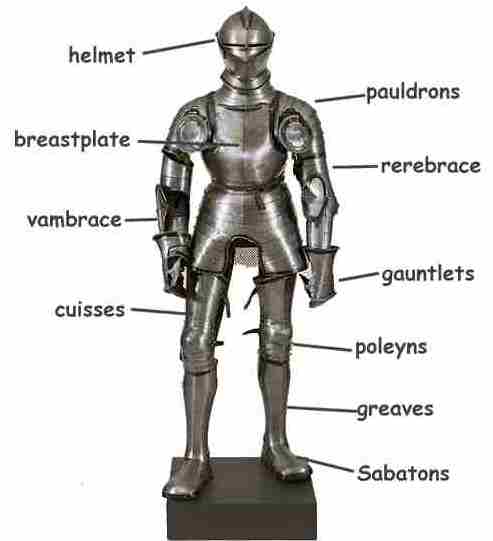
Duckster's medieval knight armor parts, edited to include "faulds" original Image Link
What better example of mighty work than a life or death battle. In my own mind, usually I think of armor as that of medieval knights, clad in shining armor. Their armor included faulds which are two leaf like sheets of metal that over lap slightly, proving protection primarily to the thighs, but also the groin.
Romans in Britain Image Link
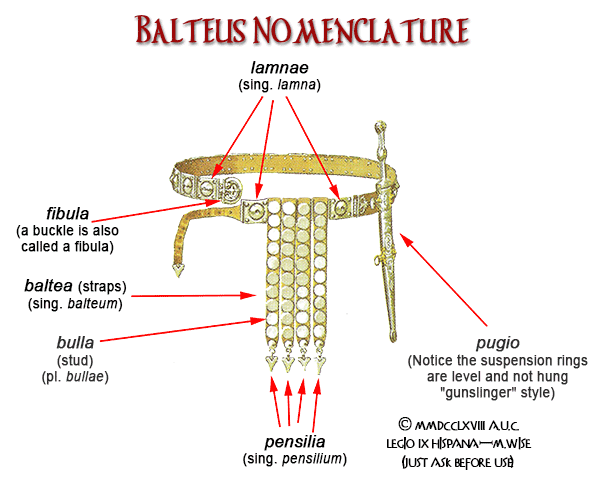
Yet it is more likely that when this armor of God was recounted in Ephesians by Paul, a Roman citizen, that he had the centurions in mind. The roman balteus or belt, has a fibula or buckle to hold them up, and baltea covered in bulla (metal studs) to protect the loins. It also has pugio which are suspension rings to attach a scabbard.
Kult of Athena Image Link
With these parts, the balteus serves to secure the tunic down to the body providing relative modesty and provides armor like protection to a vital vulnerable area as well as support to carry the sword in the scabbard. It is important it is to protect one's groin, not only because of the tenderness of testicles for men, but primarily because of the femoral artery and the external iliac vein. With one of these blood vessels punctured, an individual can bleed out in minutes.

Beyond the practical sense of physical armor, there is the doctrine it alludes to. In the case of this covering, a connection can be drawn to modesty and therefore chastity. With modest attire, we cover our nakedness, which God Himself referenced when he gave Adam and Eve coats of skins (Genesis 3:21). Today, for endowed members of the LDS church, we were a temple garment for a similar reason. It serves as a standard of modesty as well as a reminder of the covenants we made in the temple. Though the garment length has changed in these latter days, from those of long-johns to more knee length, it is important to note that it has not digressed further than the "linen breeches" the sons of Aaron would wear while in the tabernacle of ancient Israel (Exodus 28:42), in order to accommodate the ever changing modern styles.

Some may wonder why modesty is important. From the social aspect, our appearance is often how others judge us. It can also be an expression on how we see ourselves. God wants us to esteem ourselves and our bodies as something worth protecting, worth honoring, and worth sharing only with someone that would treat our bodies with equal amount of care and respect. This is not to say that judging people for how they dress is okay. Usually, the only person that I hold up to my standards is me. One most notable standard I have for myself is that I don't remove my shirt to swim. Of course there are exceptions like employers having standards for their employees, and when choosing friends and a spouse, but generally standards should come from one's own morals for one's own behavior.

Alas, this brings us to the most sexual of the ten commandments: Thou shalt not commit adultery (Exodus 20:14). Even though adultery is breaking a marriage covenant by having sexual relations with someone that is not their spouse, it was used synonymously with fornication as more emphasized in the New Testament (Matthew 5:32). With these two terms together, it seemed to cover the bases of refraining from premarital sex (fornication) and keeping faithful to one's spouse after marriage (adultery). Nevertheless, Christ holds us to an even higher standard: refraining from sexual thoughts. For he that looketh upon a woman to lust after her has already committed adultery in his heart (Matthew 5:27-28).

I understand that refraining from lustful thoughts is difficult. As a twenty-four year old young man I have had many. Yet there is a blessing in this, for it is far easier to repent of the thought than the action, for more often than not, the act of adultery or fornication can have life changing consequences. Some of which are STD's (sexually transmitted diseases), breaking apart marriages and homes, and even creating a life.

Though homosexual and lesbianic relationships can be based in love, these too violate God's laws as found in Leviticus (18:22). There is a saying that we don't choose who we fall in love with, and that is true. Indeed we are commanded to love all people even as we love ourselves (Mark 12:31). What we can choose is our actions, who we physically express that love towards, and in what manner. The church refuses none, including those who struggle with homosexuality from all the blessings God has to offer. Yet it holds to its standards, God's standards, as declared in The Family: A Proclamation to the World, "We further declare that God has commanded that the sacred powers of procreation are to be employed only between man and woman, lawfully wedded as husband and wife."

Though it is true that sin is missing the mark, and that God is love, it is incorrect to assume that having love for another human being and expressing it sexually is automatically accepted of Him. The second great commandment is to love thy neighbor as thyself (Mark 12:31), in this practicing homosexuals hit the mark and do not sin. Where they do sin is the first great commandment to love God with all their heart, might, mind, and soul (Mark 12:30). For, though they may love God, Christ's words are irrefutable, "if ye love me, keep my commandments." (John 14:15) Having love and expressing love are very different.

To help expand an explain this law, the Doctrine and Covenants includes "or anything like unto it" while speaking of adultery (Doctrine and Covenants 59:6). Not only are lustful thoughts extensions of this law, but all sexual behavior outside of a legal and lawful marriage between a man and a woman. This is why the plague of pornography is such a terrible blight. It can trigger lustful thoughts and lead to self indulgent actions under the promise of no consequences. The lies of not hurting anyone is far from the truth. Masturbation is abuse of the soul (Elder Jeffrey R. Holland "Personal Purity", Teachings of the Presidents:Spencer W. Kimball Chapter 17: The Law of Chastity). The chemicals released in the brain, such as oxytocin, form a bond or connection, and when an individual is connected to something not real in such a powerful way, it leaves sadness, emptiness and un-fulfillment. Also, the exposure to intimate parts of strangers cheapens the experience of sexual intimacy with one's soul mate. It can lead to unrealistic expectations and a constant comparison that can lead the way to darkness and loneliness.

For this cause, we have a document called, For the Strength of Youth which addresses modesty and sexual purity including the standards and advice of: "Your body is sacred. Respect it and do not defile it in any way. Through your dress and appearance, you can show that you know how precious your body is... When you are well groomed and modestly dressed, you invite the companionship of the Spirit and you can be a good influence on others. Your dress and grooming influence the way you and others act. Never lower your standards of dress. Do not use a special occasion as an excuse to be immodest. When you dress immodestly, you send a message that is contrary to your identity as a son or daughter of God. You also send the message that you are using your body to get attention and approval." (Dress and Appearance). "Physical intimacy between husband and wife is beautiful and sacred. It is ordained of God for the creation of children and for the expression of love between husband and wife... Treat others with respect, not as objects used to satisfy lustful and selfish desires. Before marriage, do not participate in passionate kissing, lie on top of another person, or touch the private, sacred parts of another person's body, with or without clothing." (Sexual Purity).

Not only is simply lying upon the body of another person part of chastity, but there are other intimacies other than sexual that should be reserved to spouses and families. As a missionary, there were a few times that it was difficult explaining to an unmarried couple that they either have to get married or live separately before they can get baptized. Of course there is the clear reason that cohabitation is a violation of the law of chastity because they are living together they have increased opportunities to fornicate (Elder Dallin H. Oaks "Love and Law"). However, the argument is also clear that as two adults, it doesn't matter where they live, if they want to have sex they can find a way. This lead me to ponder and soul search in prayer to discover why this standard is in place. It seems as though there are intimacies and intimate circumstancing that occurs within the walls of a home that God reserves for married couples and rearing a family.

I know of an individual that once said that the standards of the church are too strict, that all kids and young adults masturbate and experiment sexually, and by requiring abstinence and sexual purity the church places them into a position where it is most beneficial to lie. The truth is that it is insulting and disrespectful to say that we as human beings cannot control our sexual urges, whether as youth or as adults.

However, there is a valid argument hidden within this bleak view of humanity. There are few sins that God has labeled in degrees of abhorrence and unforgivably. They are: adultery, murder, and denying the Holy Ghost. The obvious reason is that adultery can lead to the creation of a life, something that cannot be undone with committing a worse sin of murder and can be incredibly emotional and taxing during the repentance process either giving up the child or raising it as a couple or alone as a single parent. The more concealed reason includes the many other ways the sin is committed. Lies and deceit follow this sin like flies on a corpse. Peace of mind is lost, always wondering when and where secrets will be discovered. It includes spending time and hard earned money on pornography and prostitutes. It includes the violence of rape.

In essence, yes, sexual sins place individuals in a position to lie, but if they have committed such sins, telling the truth is the only way to heal, to work on and fully repent of the sin. Indeed, truth is the way to set them free.

No wonder God has said that we need to have our loins girt about by truth. As with the roman balteus, truth protects us from the effects of sexual sins. It is has to be tailored to each individual, for the standards of sexual purity, modesty, and abstinence have to be yours otherwise there are a plethora of ways to be sorely smitten. Then, greatest of all, it is required to hold and house the sword of the Spirit. I am not saying that it is required to use or feel the Holy Ghost, but having a clean and worthy vesicle to house the Spirit of God is the only way for the power of God to be fully and completely flowing and unhindered in your life.

Alas, there is one last question to ask: what is truth?

Eternal truth, God's truth, things as they are, and as they were, and as they are to come (Doctrine and Covenants 93:24). This is the truth that is relevant. This is the truth that sets you free. Actions committed, thoughts indulged, and all the wonderful doctrines, laws and miracles of God.

Truth has also been compared to light. As with Elder Bednar's (A member of the quantum of the twelve apostles) videos on Patterns of Light, revelation can come like light and warmth. Intelligence, or the light of truth, cannot be created or made (Doctrine and Covenants 93:29). As illustrated in cartoons, a light-bulb over an individual's head represents their getting a good, or "bright" idea. I have felt this feeling before. It is pleasant and exciting. It is a moment of pure revelation. Truths and ideas flowing into one's mind like flicking a switch. It doesn't happen often, indeed usually knowledge and wisdom is gained gradually, from experimenting, and repeated confirmations from the Spirit of God with our spirits. Some things it takes years to learn, others lifetimes. And yet, truth is still truth.

Too often, people rely on their own subjective truth. Moral relativism is one of the largest growing fads. Though I am intrigued by the "truths" of different religions, of political views, philosophies and of lifestyles; I have seen that there are real, pure and undeniable truths out there. In my darkest of times, I have felt so alone. In the physical world around me, I was alone. In my heart and mind, I was alone. And yet, I knew there is an irrevocable truth, there is a God. With this truth it brings a new meaning to my cries alone in the dark, "Where are you?! Why am I so alone?! Why can't I feel you there?!" It's not because He wasn't there. It's not because He doesn't love me.

It is because there is something, whether circumstances, sins, or our mortal inability comprehend the greatness of God, that remains, separating us from Him and His presence. In Mormon talk we call this the spiritual death, which only through Jesus Christ, partaking of the grace and mercy of His atonement through repentance, that we can be saved from this second death.which death is the death of the spirit, being cut off from God and is an effect of The Fall as is the first death, mortal death, the death of the body.

I hope that you can see, as I do, that having our loins girt about by truth is being clean, being honest and pure, so we can be the warriors of God, even if we cannot feel Him there, we can know He is there and that He loves us.

Love,
Jacobugoth

Sunday, November 1, 2015

Bleach 1: Spirits and Shinigami

Dear Readers,

Whenever someone asks me what anime's I like, I always mention Bleach as one of my favorites. Quite a few people have not liked what the series has done, especially after Aizen was defeated. It is just a little too focused on Ichigo...
This can impose a problem, especially when they pushed it with Ichigo's mother being a Quincy, and Ichigo's powers are part Quincy as well. Thus, I understand why the anime stopped after the Fullbringer escapade. But I am thankful that they did not stop after Aizen. This is because, my main reason for loving this show, I can draw so many similarities to the gospel and the scriptures. It is amazing and fantastic, and I love it so much for that reason. I should note that I will be diving into this show very extensively to exhibit the parallels I have drawn over the years. Thus there should be a SPOILER alert! Also, some of the words or perceptions one could draw from this show are false doctrine. Therefore one should compare from the gospel as a foundation to the show, instead of the other way around, like bleach is the truth and a religion.

So, that being said, Ichigo Kurosaki is the main character and is some boy who can see spirits after his mother died. Now, this show often uses the word "soul" instead of "spirit", which is technically incorrect, because they are referring to spirits. "Soul" means spirit and body (Doctrine and Covenants 88:15).

Some classifications for the spirits that dwell among us, or in this world, are pluses (wholes, benign or nice spirits), jibakurei (earthbound spirits, usually attached to an object or place), tsukirei (possessive spirit, usually bound to a person), shinigami ("soul" or spirit reaper, sometimes translated to death god), hollow (a spirit that has lost its heart and become animalistic), and the movie Memories of Nobody introduced the concept of blanks (spirits having lost their sense of self, their memories).

I will talk about shinigami later on, and hollows in a continuing blog post. So let us focus on these others real quick. The spirit world is here on earth, as confirmed by Brigsham Young in Discourses of Brigham Young pg 576. Both wicked and righteous spirits are here, even premortal spirits. This is a jibakurei, the earthbound spirit.
The chains wrapped around this spirit are called the chains of fate. Probably so named to compare to the thread of the Fates in Greek mythology. Once cut, that life has ended. Similarly, when a plus or whole is first separated from its body, the chain of fate is the connection to the body. Once that is severed, they are truly dead. These chain are also so very similar to the chains that Jacob Marley's spirit had in A Christmas Carol.
About which, Jacob said, "I wear the chain I forged in life! I made it link by link and yard by yard! I gartered it on my own free will and by my own free will, I wore it!" Basically, that he had painstakingly crafted ring by ring with every selfish, materialistic, and vile action he had done during his life.  In a similar way, one could say that we forge our own fate, what lies beyond this life, and what our rewards will be.

Then note how both Jacob and this random jibakurei have their chains tied to objects. For Jacob, it was his objects, his chests of gold and silver, and his bank keys. For this jibakurei,  it is the surrounding building. We tie our fate those things that possess our hearts. Where our heart lies, there we will be also (Matthew 6:21).

Unlike the spirits in Scrooge's life, these Bleach ones have a hope, the shinigami. The shinigami have a power called konso, or soul burial. This allows the spirit, usually a plus, who is not bound to anything, to pass on to the next life. Also, the konso removes what little chain of fate remains, keeping encroachment at bay. Indeed, one could also compare these chains to the chains or bonds of death, which were broken by Christ by His resurrection, and because of that, they have no more hold upon us (Doctrine and Covenants 138:18, Alma 7:12).
Alas, if the shinigami do not intervene in time, the chain of fate begins to go through encroachment. Which entails the chain links to eat each other until they reach the spirit's "heart".
This causes them to become a hollow. I like to think of this encroachment as the gradual eating away at our personalities, heart and soul that addiction and obsession can have on us. More so, if we have these addictions and no physical body to satisfy them. How maddening that must be. No wonder the hollows are so animialistic, and cannibalistic.  They are trying to fill a hole they have created in their own heart from not seeking God in life.

Let us focus on the good guys for a minute, the shinigami. As I mentioned earlier, shinigami can be translated as "soul reaper" or "death god". Out of the two, I prefer soul reaper, but for arguments sake, I will compare shinigami to the servants of God, like spirit angels. "Wherefore, as it is written, they are gods, even the sons of God---" (Doctrine and Covenants 76:58). This is Kenpachi Zaraki, one of the shinigami captains.
Since they are spirits, they are robed with spirit matter, and indeed are made of spirit matter called reishi. Thus their swords, or ausuchi, are swords of spirit, and are made by molding spirits or reishi together, in the same way we, in the physical world, mold iron and carbon together, folding it over and over again, making a steel katana (Japanese sword). I think that it is interesting how the term it literally "folding" steel. John Taylor said, "It is true intelligence for a man to take a subject that is mysterious and great in itself and to unfold and simplify it so that a child could understand it." (Italics added) Almost like, as we study the word of God, which I will soon compare to these swords of the spirit, we gain that simple stability by truly understanding the doctrines contained in the scriptures, and then "fold" them, whether that is unfolding to share, to folding over to grow our own understanding.

In Ephesians 6:11-17, there is a description of the armor of God.
"11. Put on the whole armour of God, that ye may be able to stand against the wiles of the devil.
12. For we wrestle not against flesh and blood, but against principalities, against powers, against the rulers of the darkness of this world, against spiritual wickedness in high places.
13. Wherefore take unto you the whole armour of God, that ye may be able to withstand in the evil day, and having done all, to stand.
14. Stand therefore, having your loins girt about the truth, and having on the breastplate of righteousness;
15. And your feet shod with the preparation of the gospel of peace;
16. Above all, taking the shield of faith, wherewith ye shall be able to quench all the fiery darts of the wicked.
17. And take the helmet of salvation, and the sword of the Spirit, which is the word of God:"

Then Isaiah 59:17 says:
"For he put on righteousness as a breastplate, and an helmet of salvation upon his head; and he put on the garments of vengeance for clothing, and was clad with zeal as a cloak."

Now, we have a bunch of different descriptions of the armor of God, and obviously, Kenpachi, does not have all of those things, but I would like to makes further comparisons describing them all.

So, Kenpachi has his sword, which can be compared to the "word of God". In Doctrine and Covenants 12:2 it says: "Behold, I am God; give heed to my word, which is quick and powerful, sharper than a two-edge sword, to the dividing asunder of both joints and marrow; therefore, give heed unto my word." Therefore, comparing their swordsmanship and power as learning the word of God.
Notice that Kenpachi has a belt or obi sash holding his robes up, kind of like being "girt about" by truth, or rather hiding his nakedness. Then his robes or shihakusho (garment of dead souls) could be considered the "garments of vengeance" because shinigami can be very wrathful and could potentially be the righteous dead who serve God. His captain's cloak, a cloak of zeal, or enthusiasm. Then there is their foot wear.
Essentially, painstakingly tied and built rope and bamboo shoes called waraji. Though they are likely uncomfortable, they serve their purpose, to be light, ready for speed, and provide protection for the foot. Or, a foot "shod with the preparation of the gospel of peace". Wouldn't this be considered preparation? So, the gospel of peace is what we need to use to be prepared. Though the gospel brings us peace, it may not be the most "comfortable" of commandments, or life to live. But it is the safest and best solution for the tasks we are all called to do here in this life.
Shinigami also have an ability they can develop called flash step. It is a way to run, move, or jump, at high speeds. Though this is not specifically correlated with the feet, it is not a far leap to say that if we are prepared, we will be able to accomplish tasks with greater ease, more smoothly, and even more quickly as opposed to not being prepared. Indeed, without preparation, we will likely stumble and fall.

This leaves us with: Breastplate of righteousness, shield of faith, and helmet of salvation.
These are less literal representations, for the most part, in this show.

I will liken the breastplate to their reiatsu, or spirit pressure. It is a force that emanates from their reiryoku, or spirit power. President Thomas S. Monson, who is the current Prophet of the Church of Latter-day Saints has said, "Prayer continues to provide power---spiritual power. Prayer continues to provide peace--spiritual peace."

Thus, as we pray, we can build up our reiryoku, spirit power, and that allows us to have reiatsu, spirit pressure, or breastplate of righteousness. In Kenpachi's case, his reiatsu was so strong that a sword could hit his body, and not cut him. It is interesting to note that in Bleach, their reiryoku is directly aligned with their spiritual sensitivity and willpower. Almost like, prayer, and our communicating with God, helps us grow closer to the Spirit of God, and all the powers available therewith, as well as strengthens us against temptation. Thus we will choose to be more righteous and produce that "breastplate of righteousness", or reiatsu.

As for the shield of faith, it relates in a really round about away. For shinigami, their ausuchi can have powers. For Kenpachi, he has so much reiryoku, that his ausuchi is permantly locked in a state called a shikai. It is the next step in the sword's forging. It can only be released by the shinigami who owns the ausuchi, and its powers are connected to innermost desires of that individual. For Ichigo, this state was unlocked when he was stabbed with his own ausuchi, allowing direct communcation with the spirit withing the sword. If the sword is indeed the Spirit, or the word of God, it makes sense that sometimes we have to have it strike us to our very heart in order to accept it. Though most shinigami obtain this power through meditation and communicating with the zampakuto spirit inside. This is a less violent and miraculous means of gaining the same result or testimony. Almost, like we are supposed to meditate and ponder upon the word of God to gain its power. Or, like in the most recent General Conference, "ponderize". (Oct 2015 General Conference "My Heart Pondereth Them Continually" by Devin G. Durrant)

The fullness of the shikai can be unlocked, by learning the zampakuto's name. Again, it is more of a reflection of one's innermost thoughts and desires, but is itself a separate entity. I will talk more about zampukto in my next Bleach post.

Again, even knowing the name of your zampakuto is not necessarily enough. It takes "resolve" to cut effectively with it. This resolve can be expounded with the comparison to the word of God. We need to be resolved, not confused or confounded, or even doubtful, as to whether or not the scriptures are the word of God. Nor in what they mean to us. This resolve, allows us to effectively use and live by the word of God. (Below is Ichigo, with his shikai, gaining resolve)
The next step in the ausuchi's evolution, or more accurately, metamorphisis, is the bankai. This next stage multiplies the power exponentially. The bankai stage is obtain through acknowledging a certain truth, that the power is not just in the sword, but is also within us. With the comparison to the word of God, Yes, the word has power, but only if we use it and live by it. Thus the power is really in us, just as when, if we have the Holy Ghost, that is because we have allowed the Holy Ghost into us. It is apart of us, and touches the light of Christ within us. Basically, unlocking our own power, our own potential as children of God. It took Ichigo quite a while, battling his own zampakuto, before he realized that the power was within himself, allowing him to fight his zampakuto with Ichigo's own shikai.
I would like to note here, that with Ichigo's bankai, not only did his sword change, but his clothes as well, but not the sandals. The gospel never changes, but our ability to apply it does. We strengthen our breastplate, our zeal, and the truth that we have.
Now for how this applies to the shield of faith. Above is Ichigo fighting another shinigami's bankai with his own. Though, his opponent's bankai involves thousands of tiny swords that reflect light to shine like cherry blossoms and though there were so many blades swarming him, and only having one sword, his new powers gave him enough speed to create an effective, blade shield from the blossoms. This is the shield, and it relies entirely on faith that what they are trying to attempt is possible. Not just faith in the word of God, or the sword, but also faith in one's self. Even Ichigo's opponent here, Byakuya Kuchiki, has a safe zone that he creates with his blossoms. Creating a nearly impenetrable shield around himself.
Thus the saying, "The best defense is having a good offense." We can apply this in acknowledging that if we stand idly by, not using the word of God, we loose our defense, and become vulnerable to the fiery darts of the adversary, sin, misery, and despair.

The next topic of shinigami powers I would like to touch on is kido (spell or demon arts). Now, I am not necessarily saying that magic and spells are in the gospel, at least with the connotations that the presently have in our society, but the basic idea of spells are. When a priesthood holder gives a blessing, they are using words to summon or exercise God's power. Even when we pray we are asking for divine intervention, though often in small degrees. Thus, the words we use can act like a "spell" when God is with us.

Now there are three basic types of kido: Bakudo (way of binding), Hado (way of destruction), Kaido (healing kido).

Bakudo is usually associated in barriers and "seals". As an example of a barrier, we have Byakuya's danku, which acts like a wall.

 How often do we pray for protection from evil? How often do we seek strength to stand fast in the face of adversity? Does it not take faith to rely upon God during those troubled times? Indeed, these barriers can also be considered part or aspect of the shield of faith.

Now, as for the "seals" I have placed the word in quotations because it needs to be further defined. These are not like the sealings we do in the temple, binding one person to another. That comparison I will make a little later on. These "seals" are also not hand gestures, like the seals in Naruto, though hand seals can be applied to kido, as exhibited by Hachigen Ushoda, who is a visored. I rather think of hand seals used for kido like a sign language of prayer. They say that, "actions speak louder than words" and what better way than have actions as words. Though, as I said, that is not the kind of seals we are talking about right now. These seals are bindings upon others. Literal restraints. For example, here is the spell sai used on Ichigo.
It is for "spells" or "seals" like this that the translation of kido as demon arts makes more sense. While the barrier can be applied to God easily, these seals are directly taking away someone else's agency. This is exactly what the Devil and his angels, called demons, want. They want dominion over us, and to rule and reign while we are in subjection to them. Those of us who have and use the priesthood of God often times forget that Satan has his own priesthood, his own "honor" over those in his grasp, and he uses that power to cripple and bring people down.

I think that is enough of that dark business, so let us move on to hado. Hado can be compared duo fold, similar to bakudo's seals and barriers. One could look at hado, or attack spells, in a good way, fighting against our opponent. Like missionary work and sharing the gospel is in our world. Not just standing passively by, trying to save ourselves, but to fight back against the "fiery darts of the adversary". A "strike for Zion" like the hymn, Hope of Israel, depicts. Do we not pray for missionary opportunities which are chances to strike back?

On the other side, comparing this to the Devil's priesthood again, it would be the very "fiery darts" that need to be quenched by our shields of faith. Much like the appearance of Urahara's, another character, senjukotentaiho.


There is also a higher order of hado, called gisei hado, meaning sacrificial way of destruction. This I relate completely to the good aspect of hado. Gisei hado require a sacrifice of part of one's body. I am not condoning actually sacrificing an arm or a leg. I am merely saying that the aspect of sacrifice in combination with sharing the gospel or prayer, like the sacrifice of food when fasting, amplifies the power of the prayer. Like when Yama-jin (the head captain of the shinigami armies) used itto kaso on Aizen (the main antagonist of the series). He, Yama-jin, sacrificed his own arm in an attempt to kill Aizen. The attack displayed as a giant flaming tip of a sword, which again, was like a manifestation of the sword of the Spirit. (Note: the size scale, those are buildings at the bottom)
Next there is kaido, the healing kido. This, most simply can be expressed as a healing blessing given by a priesthood holder, or a prayer on behalf of someone that is ill. There is immense healing power, and sometimes we forget just how powerful a miracle God can perform through us His mortal instruments.

Some general aspect of kido that I would like to cover are eishohaki, niju eisho, and kojutsu eisho. Eishohaki is an unspoken spell, like the song of the heart, or simply having a prayer in one's heart. Niju eisho is a twofold incantation, meaning that there is spoken words as well as the prayer of the heart. In essence, we can say whatever we want to say in prayers, but unless our heart, emotion, and desire is behind those words, it is vain. Kojutsu eisho are words spoken after the initial incantation and are used for strengthening the spell or kido. This can easily be applied to prayer, in that, we pour out our whole soul to God, and though me might not receive an answer immediately, continue to ponder and pray throughout the coming day/s, months or years to strengthen our resolve when the answer finally comes.

Next I would like to mention shunko. Shunko is an attack that involves using kido with one's body for an attack. Essentially using kido to power up martial arts. To me, this makes so much sense from the spiritual aspect. Why would we pray and ask for God's favor and help if we did not act our part as well. Indeed, when shunko is used properly, the clothes across the shoulders and back of the neck are burnt off, like a mantle of fire, electricity or light, from God, being placed upon the individual, giving sanction to their actions. In Helaman 10:5 it says, "...I will make thee mighty in word and in deed, in faith and in works; yea, and that all things shall be done unto thee according to thy word, for thou shalt not ask that which is contrary to my will." Is this not what we are all striving for? To be so trusted by God that we can command and do as though we were Him. Our very actions and desires being so aligned with God's will, that He will let us go forth exercising His power in such abundance. Indeed, this is what the shunko symbolizes to me, and it is exquisite.

Now, I promised that I would relate the comparison of temple sealings. Temple sealings bind individuals together, for time and all eternity. They create a bond that death itself cannot destroy nor break. Is is the bonds that connect us all one to another that I wish to talk about. In Bleach, there is reiraku, which can be translated and spirit ribbons. These are generally white, representing humans, and are a bond from one human to another. All humans, specifically their spirits, are tied one to another as spirit children of God. Shinigami have red reiraku. Since I am somewhat comparing shinigami to spiritual angels or servants of God, this red ribbon could easily be considered being washed in the blood of Christ (Isaiah 1:18, 1 John 1:7).
Though the series does not talk much more about these spirit ribbons, I have drawn my own comparisons. First, since these ribbons are compared to cloth, there are different types of cloth. Silk, cotton, and polyester just to name a few. Each has its own strength, texture, and stability. Like the different relationships we have. Our relationship with our spouse might be more of a silk, and a relationship with a friend could be more of a cotton. Then there is the durability of the ribbons. Some might be easily cut or broken, others are stronger and more durable. The sealings in the temple, between a husband and wife, parents and children, are the strongest bonds or ribbons that I am currently aware of.

The greatest aspect of this ribbon comparison, at least for me, is that one can find someone through these ribbons. My mother, being a genealogist, would compare following the ribbons from one generation to the next to unite the whole human family as one solid cloth, like strings in a tapestry. However, I have always been more of a friend seeker. I want and desire friendship, and want to hold on to those bonds as long as possible. I want to know that I am not alone, that I am connected to others. Though the bonds of friendship often break, by holding onto the remnants, and growing from them, we can strengthen the bonds that we do have, and learn to make others.

Indeed, though I don't often believe it (or act like I believe it) myself, I have testified, and felt the power of the Holy Ghost while doing so, that friendships are a bond that have the potential to last forever. For those members of the church that have served missions, they will find that hardly a day goes by that they did not think of something from their mission. This continues throughout the rest of their lives. If our mortal life is our great mission throughout all eternity, then will we not be thinking and pondering about events that transpired here throughout that eternity. The friendships we made, our interactions with mankind, the activities we enjoyed, and lessons we learned. I am not saying that friendships will last forever, just that they have that potential, if that bond is continually sustained.

With this note, I am ending this Bleach post. A big shout out to bleach.wikia.com for their useful information about terms and their definitions. My next installment will include zampakuto and hollows, including arrancar. I hope that you have learned and grew in your faith and understanding as I have. I hope that you too will find ways to apply gospel principles to those things that you watch or do simply to be "entertained". As always, I would love to hear your comments and know your opinions.

Love,
Jacobugoth